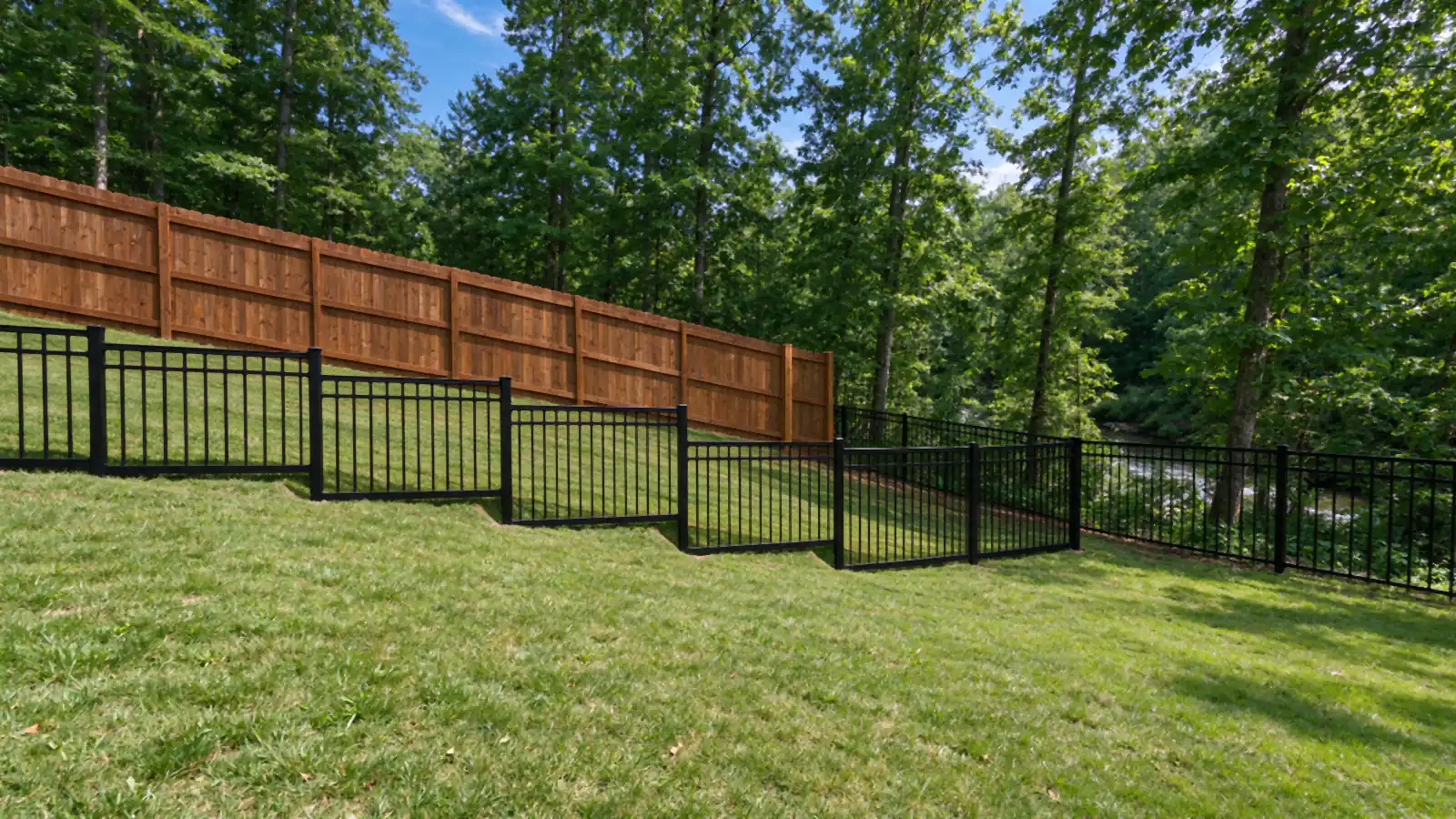
There are two ways. A racked fence tilts its rails to follow the grade while posts and pickets stay vertical, so the bottom of the fence runs parallel to the ground. A stepped fence uses level sections that drop at each post, like a staircase, leaving a triangle of open space under the downhill end of each section. Wood can be built either way. Many aluminum panels rack within a limit. Most vinyl privacy panels must be stepped.
Upright Johns Creek Fencing builds fences on sloped lots across north Fulton, where many backyards fall toward a creek, a swale or a detention pond. This guide explains how each method works and when to use it.
Racked fences
On a racked fence, the rails run at the same angle as the ground. Posts stay plumb and pickets stay vertical, but the tops and bottoms of the boards follow the slope. The result is a fence with a consistent gap under it, which matters for dogs and for looks.
Wood is the easiest material to rack, because each rail and board is cut and fastened on site. Chain link fabric follows grade naturally. Many aluminum panels are made to rack within a rated amount; beyond it, they are stepped or custom-made. The top line of a racked fence follows the ground, so on a lot that rolls up and down, the top line rolls too.
Stepped fences
A stepped fence keeps each section level, so the top line looks like a series of steps. The post at each step carries a section that is taller on the downhill side. This suits rigid panels, such as most vinyl privacy and some ornamental styles, and it suits buyers who want a crisp, level top line.
The tradeoff is the gap. On a steep slope, the triangle under the downhill end of each section can be large enough for a dog to get through, or a small child. It also lets light and views through on a privacy fence.
Which materials can follow a grade
- Wood: racked or stepped, cut to fit. The most flexible on uneven ground.
- Chain link: follows the grade almost automatically; the fabric stretches along the slope.
- Aluminum: many panels rack within a rated limit; steeper runs are stepped.
- Steel: some panels rack, but steel’s stiffness makes on-site adjustment harder.
- Vinyl privacy: usually stepped. Some picket and semi-privacy styles rack slightly.
The wood vs vinyl guide and the aluminum vs steel guide compare those materials on other points.
Closing gaps for dogs
On a stepped fence, the gaps are usually filled. Common fixes include a treated board or cut wood panel under each step, landscape timbers, block or a strip of welded wire buried along the bottom. On a wood fence, racking the section often removes the gap in the first place. Diggers need a buried barrier whichever method is used. The dog fence guide covers escape routes in more detail.
Rolling ground
Many lots are not a single smooth slope. They dip at a swale, flatten, then rise again. Here, a mix often works best: racked sections through the dips and stepped sections where the grade is steady. On wood fences, each section can be cut to its own angle. With panel systems, the posts are laid out to put steps where the ground changes, and the installer checks each panel’s racking limit before ordering.
Posts on a slope
The downhill side of each post has less soil in front of it, and stepped sections put more load on the post at each step. Posts on a grade are often set slightly deeper, and gate posts on a slope get extra attention. The post depth guide explains how depth is chosen.
Gates on a slope
A gate that swings uphill hits the ground. Gates on slopes are usually placed on the flattest spot available, hung to swing downhill or outward, or built with a bottom edge cut to the grade. Wide drive gates on a slope may need a slide or a split pair. The gate installation page covers hinges and swing direction.
Drainage and swales
Water runs downhill along a fence line. A solid fence across a swale can act like a dam, collecting leaves and debris and pushing water around its ends. Fences across drainage paths are usually built with an open bottom or a gap at the low point, and the posts are kept out of the water’s path where possible. In many subdivisions, swales and ponds sit inside drainage easements, where the city or HOA may limit what can be built; the Johns Creek permit guide explains the review.
Height on a slope
Height rules are measured from the ground, and on a stepped fence the downhill end of each section can be taller than the uphill end. Some codes and HOAs measure at the average, and some at the highest point. A section that is 6 feet tall on the uphill side may stand taller at the downhill post. Ask the building department or HOA how they measure before ordering panels.
How to decide
Choose racked when the gap under the fence matters, for dogs, small children or privacy, and when the material allows it. Choose stepped when the panels are rigid or a level top line matters more than the gap, then plan how to fill the triangles. On rolling ground, combine the two. The fence installation page covers how a job runs, and questions about a specific yard can go to the number at the top of the page or the form below. Slopes also change price; the fence cost guide explains why.