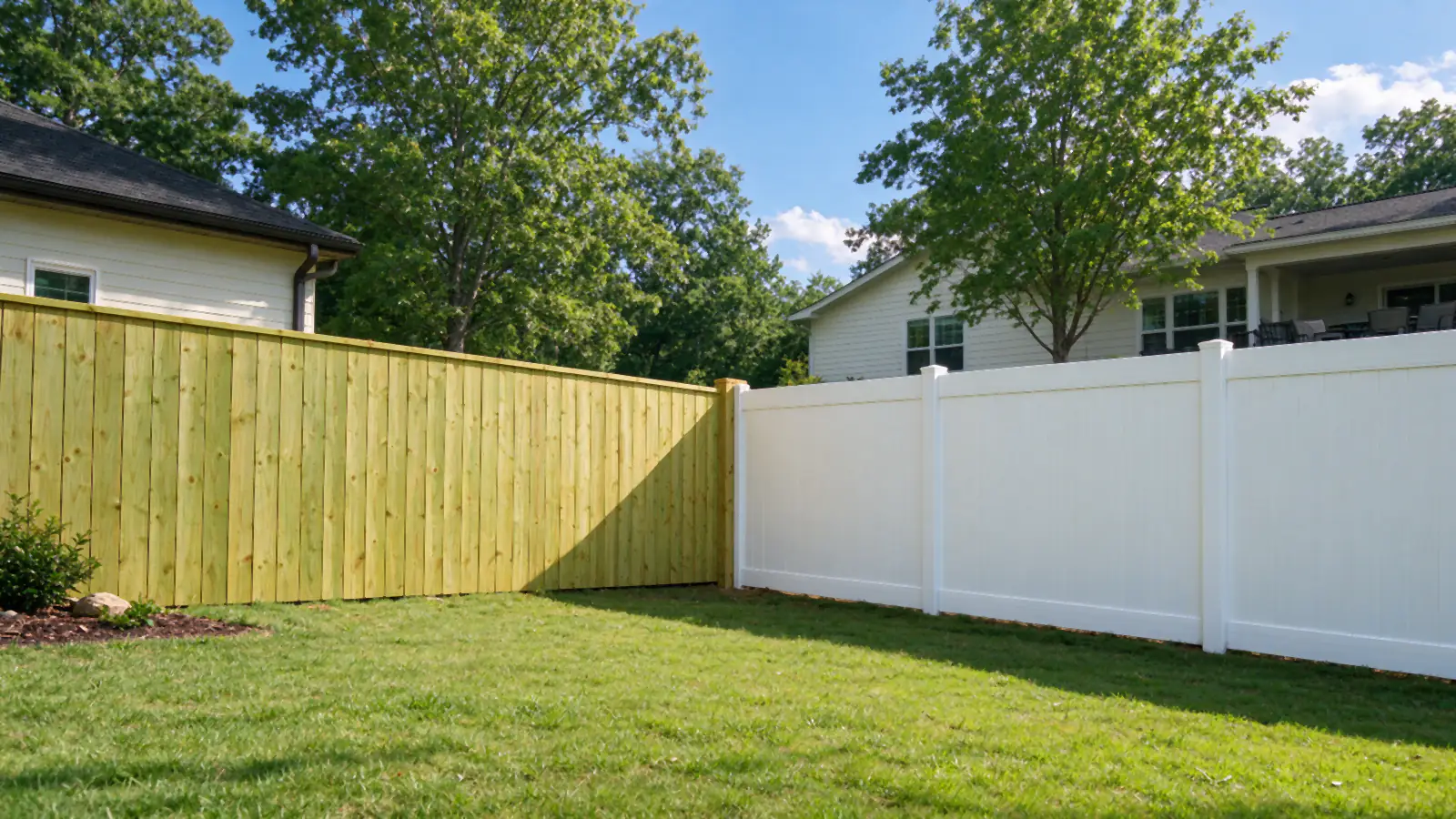
For most Johns Creek backyards, wood is the better value: it costs less to install, repairs one board at a time and is what most HOAs expect. Vinyl makes sense when you want privacy without staining and your city and HOA allow it. Vinyl cracks under impact, usually steps rather than racks on slopes, and is not allowed for new fences in Sandy Springs.
Upright Johns Creek Fencing installs both wood and vinyl fences across north Fulton. This guide compares them on the things that actually decide the choice here.
Price
Typical Atlanta-area ranges for installed fence run about $20 to $30 per foot for a 6-foot wood privacy fence and $20 to $40 for vinyl. The ranges overlap at the low end; vinyl privacy panels, taller heights and premium colors push it higher. Gates add to both, and vinyl gates need metal insert frames to stay square. The fence cost guide breaks down what else moves the price.
Upkeep in Georgia’s climate
Wood needs stain. New pressure-treated pine is stained once it dries, often a few months after installation, then every few years; fences in full sun need it more often. Without stain, wood grays, checks and cups. The staining page covers timing and products.
Vinyl never needs stain, but it is not maintenance-free in a humid climate. The shaded side grows mildew and green algae, which washes off with a hose and mild cleaner. Pine pollen coats both materials each spring.
Rot, termites and the posts
Wood fences fail at the base of the posts, where moisture, oxygen and termites meet the wood at the soil line. On north Fulton’s clay subsoils, posts set without drainage sit in water after rain. Ground-contact rated posts, a gravel base and crowned concrete extend their life a great deal; the wood fence lifespan guide explains why.
Vinyl does not rot and termites ignore it. Its posts are hollow and set in concrete too, so the footing still matters for keeping the fence straight, but decay is not the failure mode.
Impact, heat and repairs
Wood can split or break when hit by a mower, a branch or a car, but a broken board or rail is easy to replace, and new wood can be stained to blend in. Vinyl can crack on impact and becomes more brittle in cold weather. A cracked panel can be replaced if the manufacturer still makes the same panel and color; older or discontinued styles may need a close match or a full section. Recording the brand and color at installation makes later repairs easier.
Slopes
Many Johns Creek backyards slope toward a creek or a swale. Wood can be built either way on a slope: racked, with rails following the grade, or stepped, with level sections. Most vinyl privacy panels are rigid and must be stepped, leaving a triangle of open space under each panel on the downhill side. That matters for dogs and for looks. The slope guide compares the methods.
Where each is allowed
Wood is allowed everywhere nearby. Vinyl is allowed in Johns Creek, though the zoning code limits plastic fencing along streets in single-family subdivisions (confirm with the city). Sandy Springs prohibits new vinyl fences except to replace existing vinyl in kind. Peachtree Corners does not list vinyl among its permitted fence materials. HOAs may restrict either one, or limit vinyl colors. Check the rules for your address before choosing.
Privacy and wind
Both give full privacy. Board-on-board wood and solid vinyl panels catch the most wind, so posts and footings are sized for it; shadowbox wood and semi-privacy vinyl let some air through. The board-on-board vs shadowbox guide covers the wood options.
A third option: composite
Composite boards look like wood and need no stain. They cost more than either, are usually installed in level sections on aluminum or steel posts, and like vinyl, are matched by manufacturer and color. They suit owners who want a wood look and little upkeep, where the HOA allows them.
How to decide
Choose wood if cost, easy repairs, slopes or HOA expectations matter most, and you are willing to stain. Choose vinyl if you want privacy without staining, your yard is fairly level, and your city and HOA allow it. If your lot sits in Sandy Springs or Peachtree Corners, check vinyl first. The vinyl and wood pages go further into each, and questions about a specific yard can go to the number at the top of the page or the form below.
Noise and wind on exposed lots
Neither material is a true sound barrier, but a solid fence with no gaps blocks more road noise than an open one. Board-on-board wood and solid vinyl panels perform similarly. On exposed lots, both catch wind; heavier posts and closer spacing matter more than the material. A vinyl fence’s hollow posts are often reinforced with metal at corners and gates for the same reason.
Resale and neighborhood fit
In many Johns Creek subdivisions, a well-kept wood privacy fence in the neighborhood’s standard style is what buyers expect to see. Vinyl reads as low-maintenance, which some buyers value. Either one in poor repair, gray and leaning or green with mildew, works against a sale.