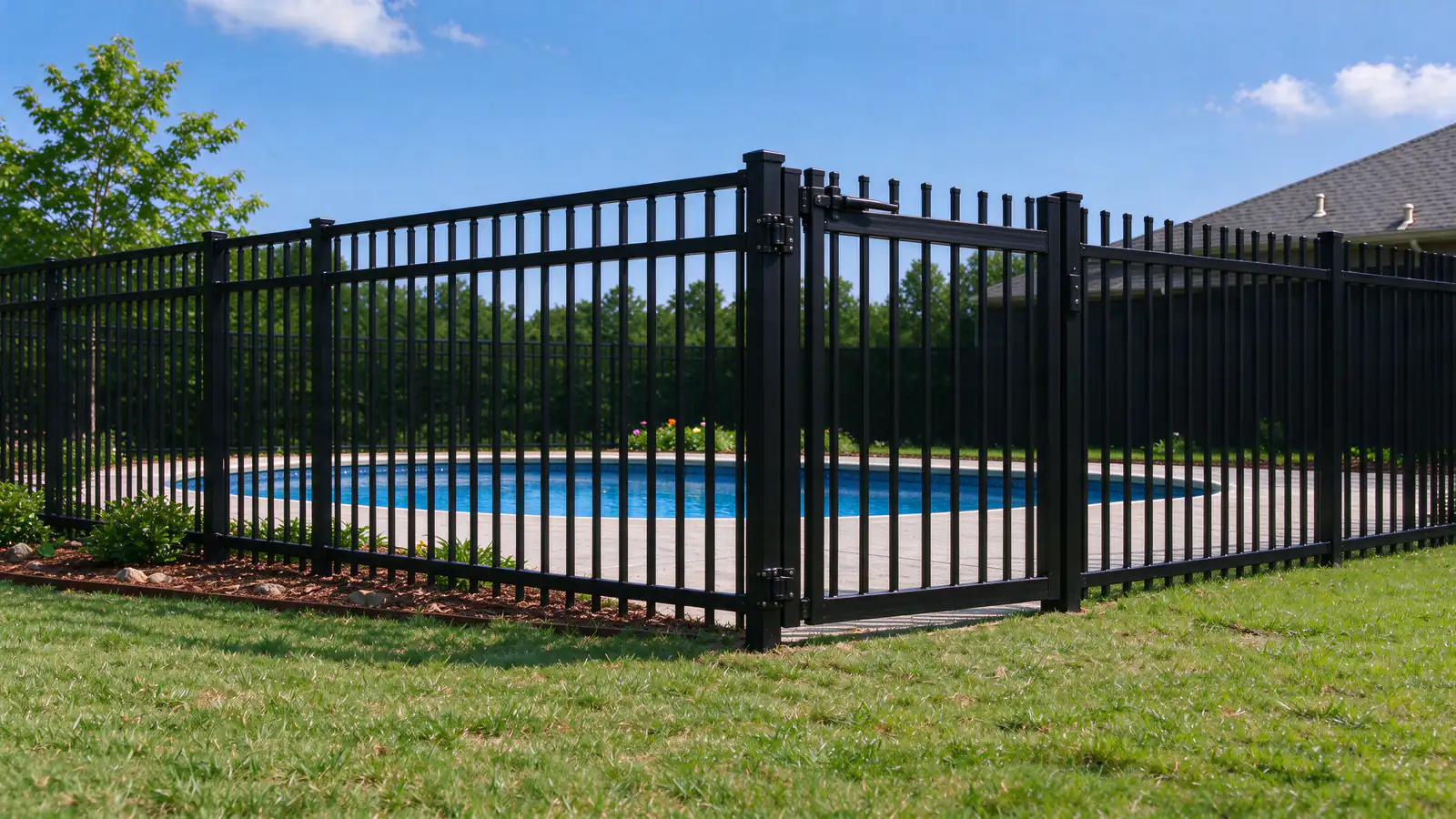
Georgia sets its pool rules through the state minimum codes. The Department of Community Affairs adopts the International Swimming Pool and Spa Code (ISPSC) with Georgia amendments, and cities and counties enforce it through pool permits and inspections. In practice, the barrier for your pool is whatever the local building department approves and inspects under that code. The Consumer Product Safety Commission’s barrier guidelines explain the reasoning behind most of the requirements.
Upright Johns Creek Fencing builds pool fences across north Fulton and plans each one with the pool contractor and the permit. This guide explains who sets which rule and what a barrier is checked for.
Who sets the rules
Three layers apply to most backyard pools here:
- The state code. Georgia’s minimum standard for pools and spas is the ISPSC with state amendments, adopted by rule. The edition and amendments change over time, so the building department confirms which apply on your permit date.
- The local permit. Your city or county issues the pool permit, reviews the barrier plan and inspects it. Some cities handle the barrier as part of the pool permit; Roswell, for example, permits and inspects pool fences with the pool. The service area pages cover nearby cities.
- The HOA. Covenants may limit the fence’s style, color or height. HOA approval does not replace the permit, and the permit does not replace HOA approval. The HOA approval guide covers that process.
The federal guidance behind the rules
The CPSC’s Safety Barrier Guidelines for Home Pools (Publication 362) is not a law, but it lays out how children get past barriers and how to stop them. Local codes and the guidelines share most of their logic, and the guidelines are a good way to understand what an inspector will look for. Where they differ, the local code is what counts.
Height and climbing
The guidelines put the top of the barrier at 48 inches or more above grade, measured from the outside, and note that some places require 60. A child who cannot reach the top cannot pull over it, and nothing on the outside should help: no horizontal rails spaced like a ladder, no decorative cutouts big enough for a toe, and no planters, grills or furniture parked against the fence.
Horizontal rails matter most on wood fences. When the tops of the rails sit less than 45 inches apart, the guidelines put the rails on the pool side and close vertical gaps to 1¾ inches or less. When the rails are 45 inches or more apart, they may face out with vertical gaps up to 4 inches.
Gaps and openings
The space under the fence is kept to 4 inches or less in the guidelines, and on sloped ground that is checked along every foot of the line, not just at the posts. The slope guide explains why stepped panels leave triangles to fill. Openings in the fence itself should be too small for a child to pass through. For chain link, the guidelines limit the mesh to 1¼-inch squares, or 1¾ inches with slats fastened top and bottom.
Gates
Most pool barrier failures happen at gates. The guidelines call for pedestrian gates that open outward, away from the pool, and close and latch on their own. A latch release lower than 54 inches from the bottom of the gate goes on the pool side, at least 3 inches below the top, where a child reaching over cannot work it. Self-closing hinges lose tension over time, and posts that lean pull gates out of line, so gates are tested from any open position, including barely open. The sagging gate guide explains why gates drift.
The house as one side
On many lots the back of the house forms one side of the pool area. Doors and windows that open onto it then need their own protection under most barrier codes, such as door alarms, self-closing and self-latching doors, or a power safety cover on the pool. That is decided in the pool permit, before the fence is laid out.
Spas and above-ground pools
Barrier codes typically let a spa or hot tub rely on a lockable safety cover in place of a fence. An above-ground pool’s wall can count as the barrier when it is tall enough, with a ladder that is removed, locked or enclosed when the pool is not in use. The local permit confirms what a specific pool needs.
Existing pools and old fences
Codes generally apply when a pool or barrier is built, permitted or altered. An older barrier is not automatically brought up to today’s code, but failed gates, gaps and footholds are still dangers. If you are adding a pool to a yard with a fence, the fence can form part of the barrier only if every part of it meets the requirements; changing gates, closing gaps and moving rails are common fixes.
Materials
Aluminum is the usual choice because pool-rated panels are made to barrier spacing and the metal does not rust near pool water; the aluminum vs steel guide compares metals. Wood privacy fences work if rails face the pool and the gates close reliably. Removable mesh fences are made for pools. Chain link works within the mesh limits.
Dogs and pools
A barrier built to keep out a toddler usually keeps out most dogs too, though small dogs can sometimes fit where a child cannot. Where that matters, closer spacing at the bottom is added. The dog fence guide covers pets in the yard.
Before you build
- Check the pool permit’s barrier requirements with the building department.
- Get HOA approval for the style.
- Plan gates first, then the fence around them.
- Keep the outside of the fence clear of anything climbable.
The Johns Creek permit guide covers the city fence process. Questions about a specific pool can go to the number at the top of the page or the form below.