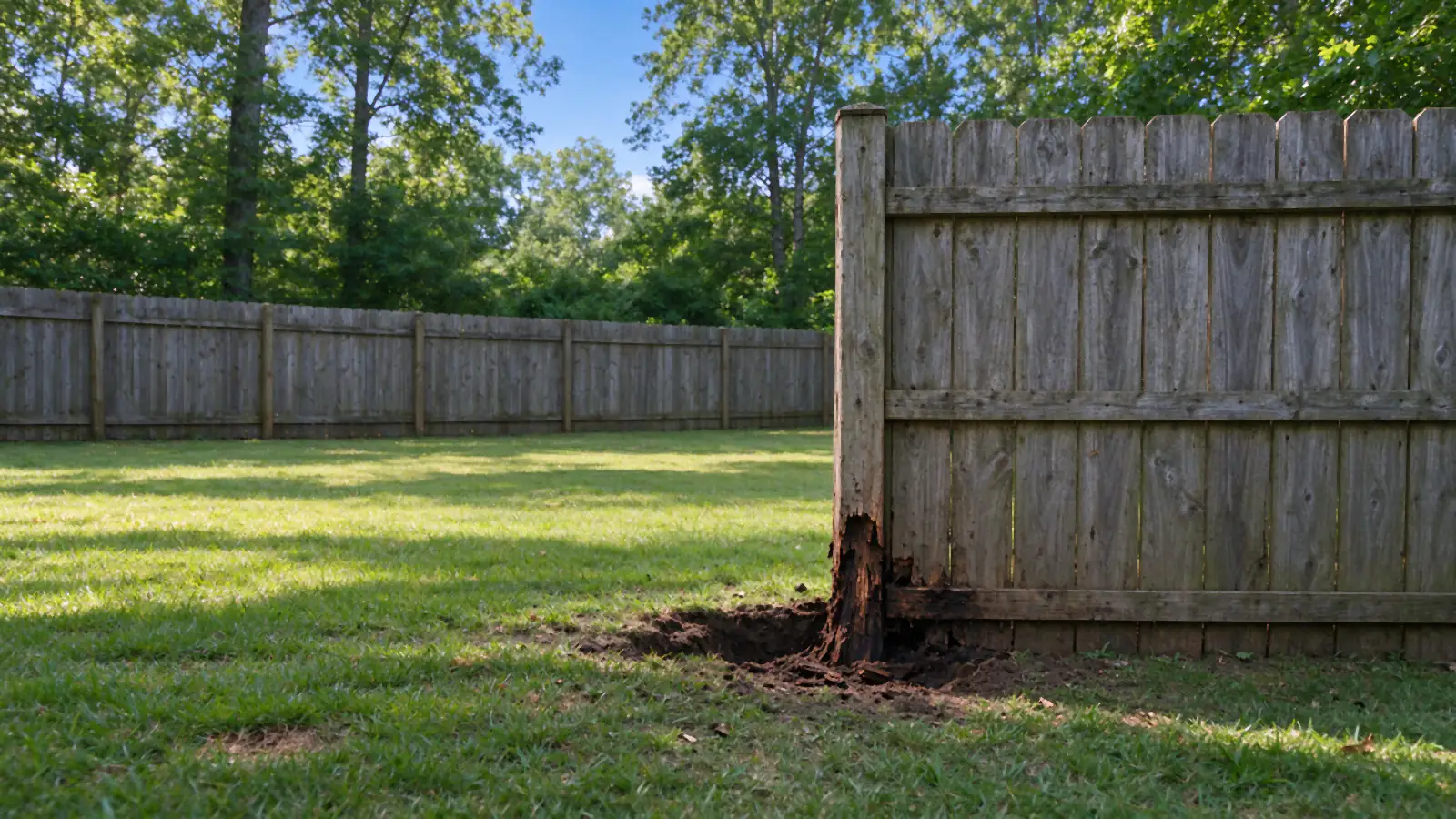
There is no single number. A wood fence lasts as long as its posts hold up where they enter the soil, and that depends mostly on how they were set: ground-contact rated posts on a gravel base with concrete crowned to shed water outlast posts packed into wet clay by a wide margin. Boards and rails can be replaced along the way. Stain, sprinklers, shade and termites decide how much upkeep the fence needs in between.
Upright Johns Creek Fencing builds and repairs wood fences across north Fulton, and most of the old fences we see came down for the same reason. This guide explains what wears out first and what adds years.
Where wood fences fail first
Walk any older fence in a Johns Creek subdivision and the pattern repeats. The pickets are gray but mostly sound, the rails are intact, and the posts are leaning. Dig at the base of one and the wood just below the soil is soft or gone.
That zone, from a few inches above grade to a foot or so below it, has everything decay fungi and termites need: moisture, oxygen and wood. Deeper in the hole there is less oxygen; higher up the wood dries between rains. At the soil line it never fully dries. A post that fails there takes the rails and boards with it, even when they still have years left in them. The leaning post guide covers what to do when one starts to go.
What north Fulton soil does to posts
The soils around Johns Creek are mostly Piedmont types with clayey subsoils, according to federal soil survey data. Clay drains slowly. A post hole dug into it and backfilled with concrete or soil can hold water like a cup after a heavy rain, keeping the base of the post wet for days. Lots near creeks sit on bottomland soils that flood occasionally and stay damp.
That is why the hole matters more than the post. A gravel base under the post lets water drain out of the hole instead of pooling against the end grain. Concrete brought slightly above grade and crowned away from the post sheds rain rather than collecting it. Those two details do more for a fence’s life than any choice of board style. The post depth guide explains how depth and drainage are chosen together.
Pressure-treated pine vs cedar
Most fences here are pressure-treated southern yellow pine. Treated lumber is rated for its use, and posts should carry a ground-contact rating, which means more preservative was forced into the wood than in lumber meant for use above ground. Lumber rated only for above-ground use, set in the soil, is usually the first part of a fence to rot.
Cedar is chosen for its looks and because it shrinks, cups and twists less as it dries. Its heartwood resists decay above ground. In the ground, though, cedar posts generally fail sooner than ground-contact treated pine, so many cedar fences are built on treated pine posts or galvanized steel posts with cedar rails and boards. Steel posts remove the soil-line problem entirely, at a higher cost.
Termites and carpenter bees
Subterranean termites are active throughout Georgia and find fence posts the same way they find a house: through the soil. Treated posts resist them; untreated or poorly treated posts can be hollowed from the inside while the outside looks sound. A screwdriver pushed into the base of a post is the quickest test.
Carpenter bees bore round holes into the face and ends of rails and cap boards, especially bare or weathered wood. They rarely bring a fence down, but their tunnels let water in. Stain and paint discourage them.
Sprinklers, shade and stain
Water that hits a fence every day shortens its life. Sprinkler heads aimed at the boards keep the bottom of the fence wet, feed mildew and speed rot where boards meet the ground. Re-aiming the heads is free.
Shade works the same way more slowly. Fence lines under hardwoods or on the north side of a house dry slowly and grow algae. Full sun does the opposite: ultraviolet light breaks down the surface fibers, the wood grays, and boards check and cup as they wet and dry.
Stain slows both. A penetrating stain repels water and blocks some ultraviolet light, so boards move less and stay sound longer. New pine is stained once it has dried enough to absorb it; the new fence staining guide covers timing, and fence staining covers what the work involves.
Ground contact at the bottom of the boards
Boards that touch the soil or mulch wick water up into their end grain and rot from the bottom. A fence built with a small gap under the boards, or a pressure-treated rot board run along the bottom that can be replaced on its own, keeps the pickets off the ground. On slopes, stepped sections leave triangles of open space that dogs may use; racked sections follow the grade more closely. The slope guide explains the tradeoff.
Repair as the fence ages
A wood fence rarely fails all at once. One or two posts go first, usually at a gate, a corner or a low spot where water collects. Replacing those posts, re-fastening loose rails and swapping split boards can keep the rest going for a long time. At some point, though, the posts are failing in many places at once and repairs cost more than they save. The repair or replace guide walks through that decision, and fence repair covers the work itself.
Gates wear first
Gates take the most stress on any wood fence. Every swing loads the hinge post, and a gate that drags or sags puts more strain on it. Gate posts are larger and set deeper than line posts for that reason, and a brace or steel frame keeps the gate square. The sagging gate guide explains why gates drop.
What adds years
- Ground-contact rated posts, or steel posts with wood rails and boards.
- A gravel base under each post and concrete crowned above grade.
- Boards kept off the soil and mulch, with a replaceable bottom board.
- Sprinklers aimed away from the fence.
- Stain applied once the wood dries, then renewed on schedule.
- Prompt repair of a leaning post before it pulls the rails out of line.
Questions about an older fence, or about building a new one to last, can go to the number at the top of the page or the form below. If replacement is the answer, the fence replacement page covers tear-out and rebuilding.