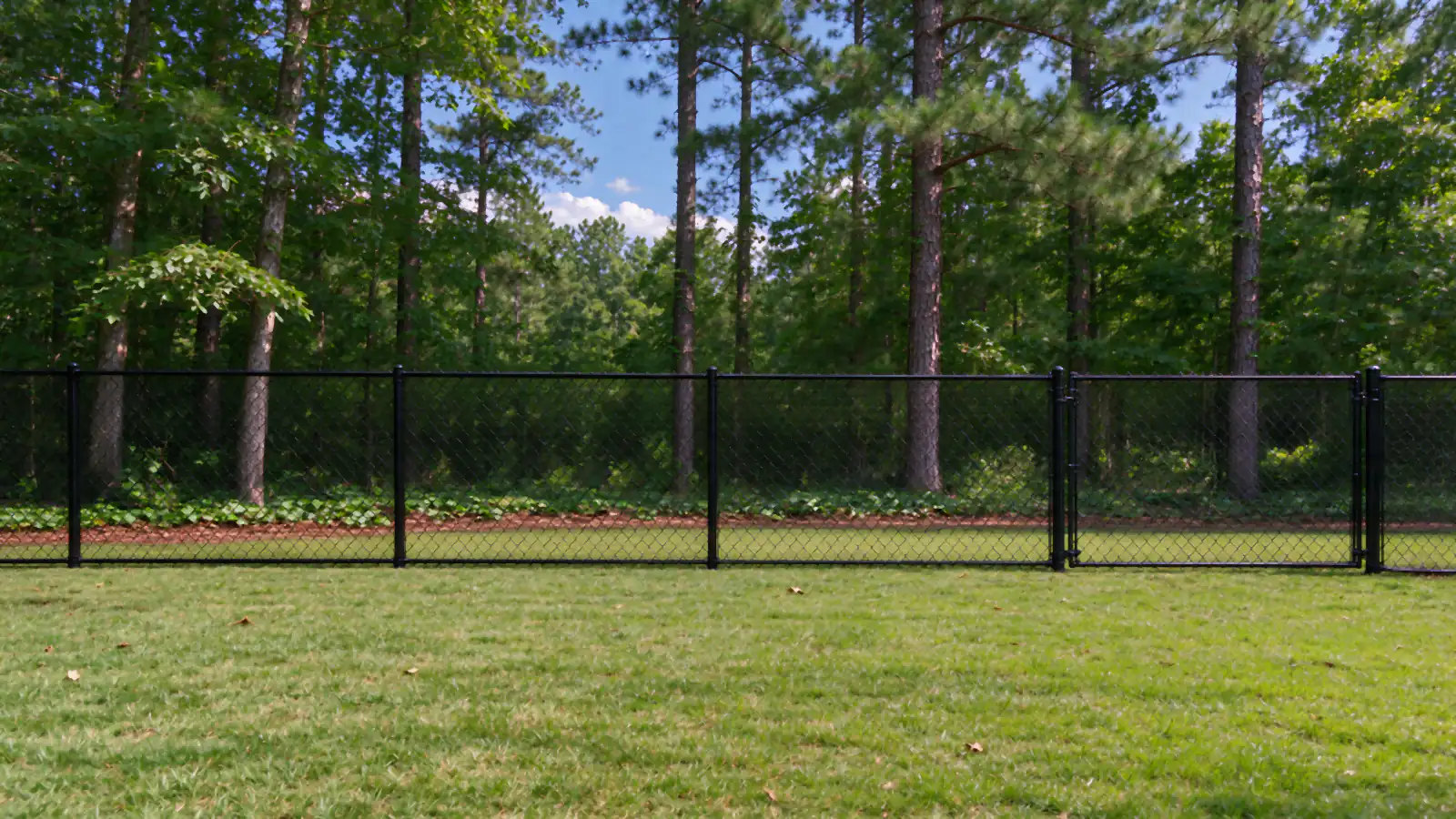
Upright Johns Creek Fencing installs chain link fences across Johns Creek and north Fulton, with the work done by licensed and insured fencing contractors. Chain link is the lowest-cost way to fence a yard and one of the most durable. It keeps pets in, marks a line, and lasts for decades when the framework is set properly. Its limits are privacy, which it does not give, and placement, because several local codes restrict where it can go.
What happens on the first visit
The visit measures the line, checks the grade and marks gates, and asks what the fence is for. Keeping a dog in calls for a tight bottom and a latching gate; marking a boundary or fencing a garden is simpler. Where the fence runs is checked against the local code: in Johns Creek subdivisions, chain link cannot adjoin a street, and in Sandy Springs and Peachtree Corners it must be vinyl-coated and kept to side and rear yards. HOA rules on chain link are checked as well; some do not allow it at all.
The estimate lists the fabric and coating, height, framework, gates, tension wire, the Johns Creek permit and tear-out of any old fence.
Where chain link is allowed
The Johns Creek zoning code does not allow wire or plastic fencing, including chain link with plastic or wooden inserts, adjoining a street right-of-way in single-family detached developments (confirm with the city). The code does allow chain link security fencing around stormwater facilities, which is common in subdivisions. Sandy Springs allows chain link only in side and rear yards, not parallel to a street, and only vinyl-coated. Peachtree Corners permits vinyl-coated chain link in side and rear yards only and does not allow uncoated chain link or woven wire. On corner lots and along roads, aluminum is often the alternative; see the aluminum fence page.
How a chain link fence is built
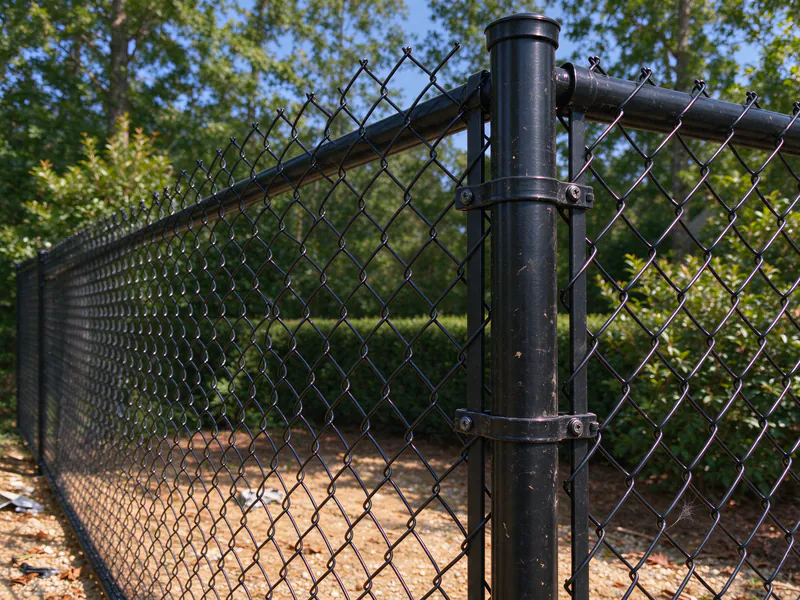
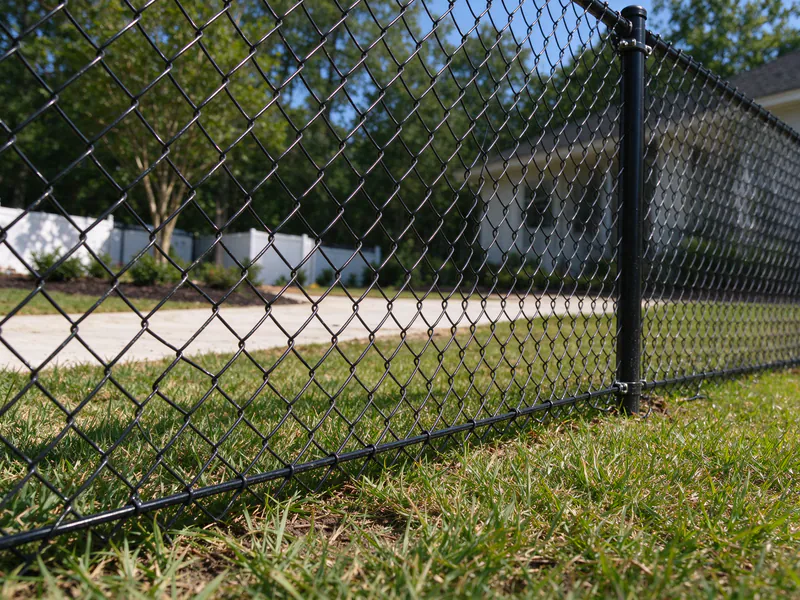
A chain link fence is a framework with fabric stretched across it. Terminal posts at the ends, corners and gates carry the pull of the fabric, so they are larger than line posts and set deeper in concrete. Line posts are spaced evenly between them. A top rail runs along the posts, and a bottom tension wire keeps the bottom of the fabric tight to the ground.
The fabric is attached at one terminal post with a tension bar and bands, stretched to the next terminal post with a stretcher, and fixed there the same way. Then it is tied to the line posts and top rail. A fence that is stretched properly stays flat for years; one that is only tied to the posts sags between them. Each terminal post gets a gravel base in its hole so the clay does not hold water against the steel, and concrete crowned to shed water.
Galvanized or black vinyl-coated
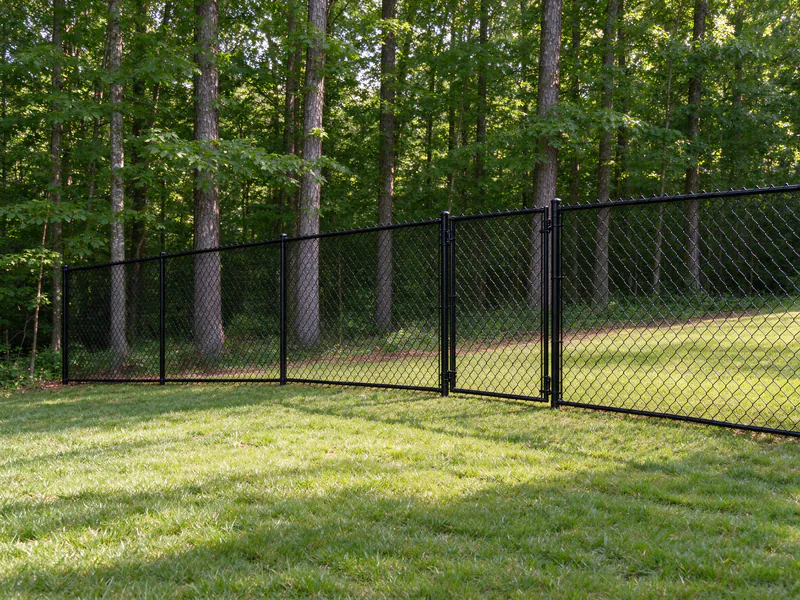
Galvanized chain link has a zinc coating that protects the steel. It is the lowest-cost option and starts bright, dulling to gray over time. Black vinyl-coated chain link has a vinyl or polymer coating over galvanized steel and comes with matching black posts and rails. In wooded Johns Creek backyards it nearly disappears against the trees, which is why many homeowners and HOAs prefer it. It is also the only type allowed in Sandy Springs and Peachtree Corners.
Fabric gauge and mesh size matter too. Heavier gauges resist bending from dogs and impacts, and smaller mesh is harder to climb. For pool barriers, mesh openings have to be small enough to meet barrier guidelines; see the pool fence page.
Keeping dogs in
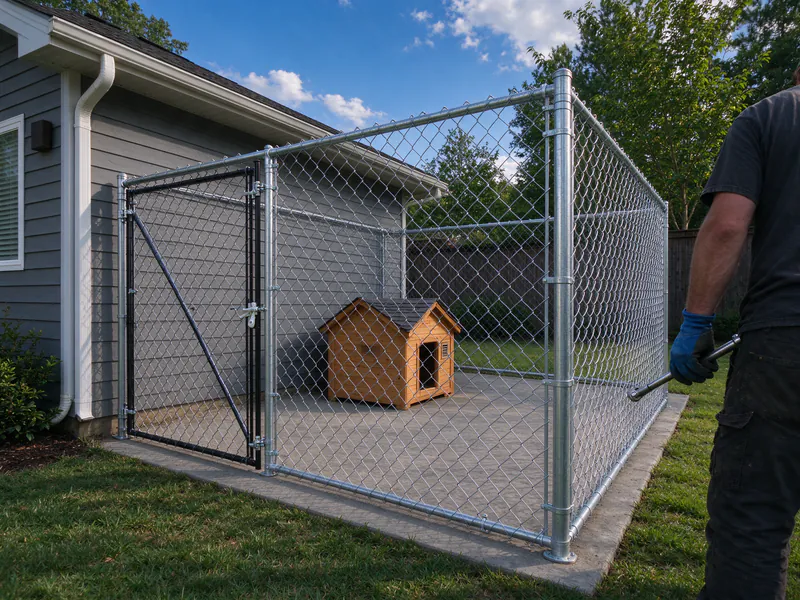
Chain link is a common choice for dogs because it is strong, does not block the view and costs less than other materials. Most escapes happen in three places. At the bottom, a bottom tension wire keeps the fabric from being pushed up, and dogs that dig need a buried wire apron or a concrete strip. Over the top, jumpers need taller fabric. And at the gate, a latch that closes on its own matters more than any other detail. The dog fence guide covers each case.
Privacy slats and screening
Slats woven into chain link add some screening, but they also turn an open fence into a solid one that catches wind, so posts and footings need to be heavier. Johns Creek does not allow chain link with inserts along streets in subdivisions. For a rear line that needs real privacy, a wood privacy fence usually screens better. The chain link vs wood guide compares the two.
Gates in chain link
Chain link walk gates are light and stay square on properly set gate posts. Drive gates for trailers or equipment are often double gates with a center drop rod and a stop. Rolling and cantilever gates are used where a swing gate has no room. All gates get latches that close without lifting. More on gates is on the gate installation page.
Commercial and stormwater fencing
Chain link is the usual fence for stormwater ponds, utility areas, storage yards and other commercial and HOA sites, often with heavier framework and taller fabric. Commercial work is covered on the commercial fencing page.
What chain link costs
Chain link typically runs about $8 to $24 per foot installed in the Atlanta area, before gates, tear-out and the $75 Johns Creek residential permit. Galvanized fabric at standard heights sits toward the low end; black vinyl-coated fabric, heavier framework, taller fences and bottom barriers for dogs push toward the high end. The fence cost guide shows how an estimate adds up.
Heights and fabric choices
Residential chain link is most often 4 feet tall for yards and gardens, with 5 and 6 feet used for larger dogs and security. Taller fabric needs heavier terminal posts and closer line posts, because the fabric’s tension and the wind both increase with height. Heavier gauge fabric and smaller mesh cost more but resist bending and climbing, which matters for active dogs and around play areas. Fabric is ordered to the height of the fence, with no splices in a run.