Upright Johns Creek Fencing handles commercial fencing for HOAs, businesses and property managers across Johns Creek and north Fulton, with the work done by licensed and insured fencing contractors. Commercial fences do the same jobs as residential ones, containing, securing and screening, but on sites where many people depend on them and where approvals, scheduling and documentation matter as much as the fence itself.
The most common commercial projects in Johns Creek are around subdivision amenities and infrastructure: fences around stormwater ponds, barriers at neighborhood pools, entrance features and screening along the edges of common areas. Office parks, retail centers, churches, schools and storage yards add security fencing, dumpster enclosures and gates.
What happens on the first visit
The first visit is a site walk with whoever manages the property: a board member, a community manager or a facilities lead. It covers the scope, how the site is used, where the public and residents are, where materials can be staged and when work can happen. Existing fences are checked for what can stay. Any gates, especially automated ones, are reviewed for how they are used.
From that, the estimate includes a written scope, product data for approval, a schedule, the commercial permit and how the site will be kept safe during the work.
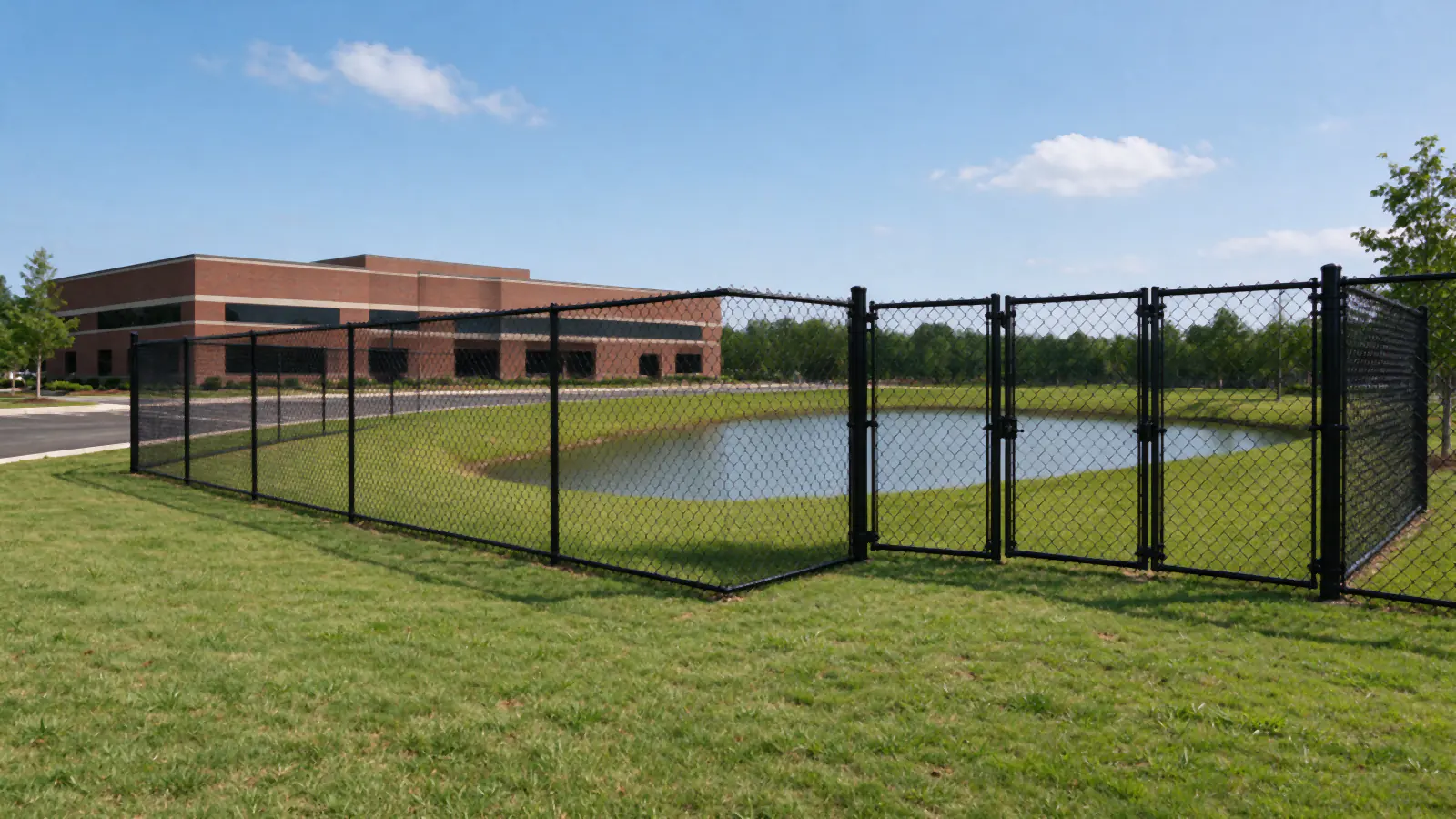
Stormwater ponds and detention areas
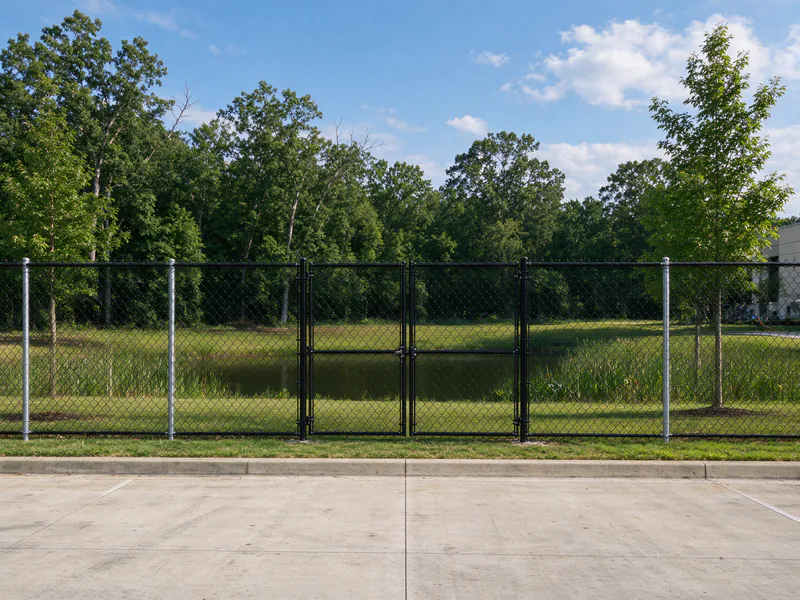
Stormwater facilities are common in Johns Creek subdivisions and commercial sites, and many are fenced to keep people out of steep banks and moving water. The Johns Creek zoning code allows chain link security fencing around stormwater facilities, even where chain link is otherwise limited along streets in single-family subdivisions (confirm with the city for the site). These fences need maintenance access: gates wide enough for mowing equipment and the trucks that service outlets and pipes. Ground near ponds is often soft or wet, so posts are set with drainage and depth for the conditions. The chain link page covers framework and fabric choices.
Amenity pools and recreation areas
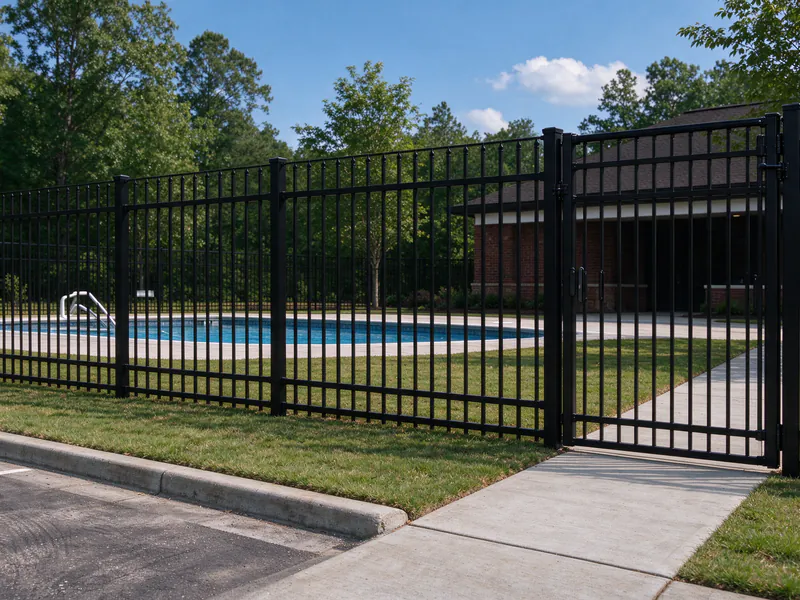
Neighborhood pools need barriers that meet the pool code, and they see heavy use, so gates take a beating. Self-closing hinges and self-latching hardware are chosen for frequent cycling and checked after installation. Aluminum is the usual material because it keeps the pool visible to staff and residents. Damage to an amenity pool barrier is treated as urgent; a temporary barrier can close the gap until the permanent repair is done. See the pool fence page for barrier details.
Security fencing and gates
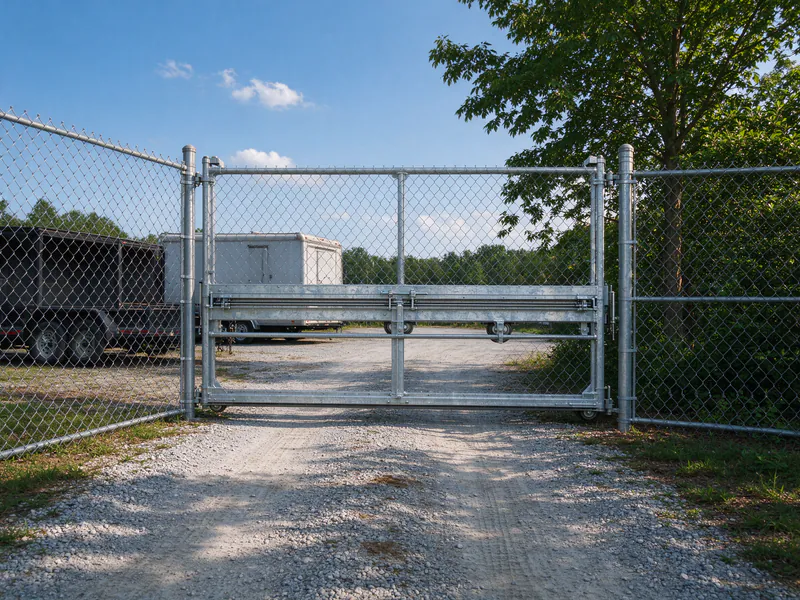
Storage yards, utility areas and the backs of commercial buildings often need security fencing: heavier chain link framework, taller fabric, and gates that can be locked. In Johns Creek, barbed wire is not approved on single-family lots, but the zoning code allows security strands in other districts above a minimum height (confirm with the city). Vehicle gates may be swing, rolling or cantilever, and automated gates follow UL 325 for operators and ASTM F2200 for construction; see the automatic gate page.
Screening and enclosures
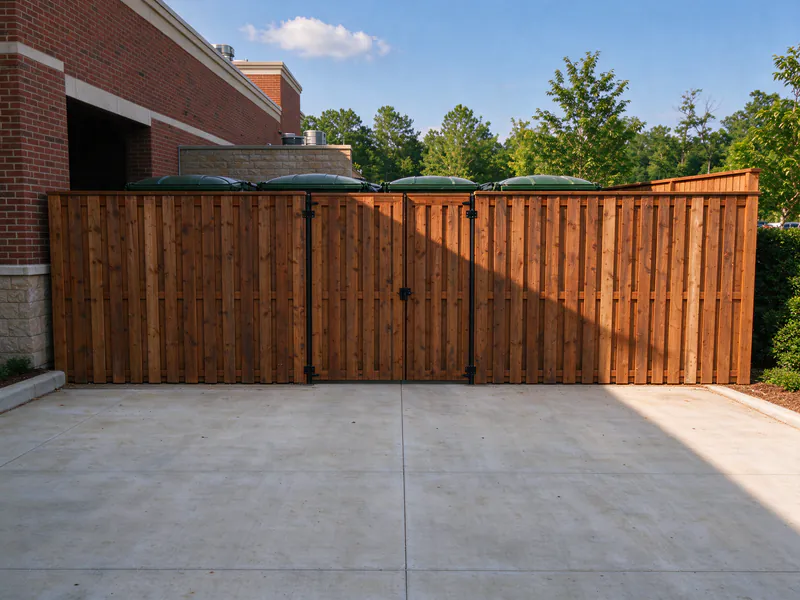
Dumpster and equipment enclosures, and screening between commercial sites and neighboring homes, usually use wood or composite panels on steel posts, sometimes with masonry. Enclosures need gates wide enough for collection trucks and hardware that survives being slammed. In Sandy Springs, commercial dumpster enclosures go through a building permit with a site plan, and Fulton County approval may be needed for a dumpster pad.
Permits and approvals
Johns Creek charges $100 for a commercial fence permit. Other cities differ: in Sandy Springs, commercial fences and subdivision complex enclosures are reviewed by both the Building Division and the Fire Marshal’s Office. HOA common-area projects may also need approval from the board or the architectural committee, and commercial properties may have their own design guidelines. The Johns Creek permit guide covers the city’s process.
Working around occupants
Commercial sites stay in use while fences go in. Work is scheduled around access windows, quiet hours and events, materials are staged where they do not block parking or walkways, and gates and openings are secured at the end of each day. On pool and stormwater fences, temporary fencing keeps the area closed while the permanent fence is built.
Documentation and closeout
Boards and property managers usually need records: the scope, product data, the permit and photos of the finished work. Those are provided at closeout so they can go into the property’s files. For ongoing properties, a note of hardware types and gate settings makes later repairs simpler.
Repairs and replacements on commercial sites
Commercial fences take impacts from vehicles, mowers and storms, and gates wear out from heavy use. Repairs focus on restoring security and safety first: closing gaps, re-hanging gates and replacing bent framework. Where a fence is failing along most of its length, replacement is priced alongside the repair so the board or owner can compare. The repair or replace guide explains the decision.
What commercial fencing costs
Commercial projects are priced per site, because framework weight, fabric, heights, gates, access and scheduling vary widely. Typical Atlanta-area residential ranges, such as $8 to $24 per foot for chain link and $25 to $50 for aluminum, are a starting reference, with commercial specifications usually toward the high end. The fence cost guide explains what drives the numbers.
Fences for schools, churches and play areas
Schools, churches, daycares and playgrounds need fences that keep children in defined areas and keep vehicles out. Common choices are aluminum or vinyl-coated chain link at heights that suit the age group, with gates that latch reliably and can be locked after hours. Openings and spacing are chosen so small children cannot climb or squeeze through, and gates near parking lots are placed so drop-off traffic does not cross play areas. Gates on these sites see heavy daily use, so hinges and latches are selected for frequent cycling and checked after installation.
Entrances and frontage
Subdivision entrances and commercial frontage often combine masonry columns with aluminum or ornamental steel panels. Along streets in Johns Creek, fences stay 3 feet off the public right-of-way with a landscape strip, and sight distance at driveways and intersections stays clear (confirm with the city). Those limits are drawn on the site plan before columns are placed.